
The further expansion and upgrade of the Chinese military does not augur well for India, which continues to confront an increasingly belligerent China on its borders, notes former foreign secretary Shyam Saran.
He said that the two nations will have issues in the foreseeable future. However, there are ways of addressing those issues and what happened in 2020 was not the way to address those issues.
The political-electoral calculus favours spending thousands of crores on vanity projects like Sardar Patel's statue and the Central Vista over building up our military to handle the confrontations and conflicts that loom large, points out Ajai Shukla.
There is growing alarm at the inexorable rise of China, both of its military prowess and its aggressive bullying of other countries plus its subjugation of whole portions of its own population.

The "bumper" 40 per cent increase followed a number of sweeping reforms intended to transform the "bloated People's Liberation Army, into a more modern, nimble fighting force".

The defence budget was increased to Rs 5.94 lakh crore for 2023-24, up from last year's allocation of Rs 5.25 lakh crore.
'Is the Agniveer scheme or their post-retirement re-employment in paramilitary forces or in the state governments the BJP's answer to the crying need on the job front?' 'Or, even Finance Minister Sitharaman's one-year internship scheme in the public and private sector, is it a permanent solution, either?', asks N Sathiya Moorthy.
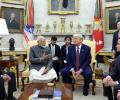
'By his words, actions, and body language during their joint press appearance wanted to convey his personal respect and, more broadly, his desire to work closely with India.'

Excluding the pension outgo, the allocation in the Union Budget for the armed forces stands at Rs 3.62 lakh crore.

Even as Chinese troops continue squatting on territory that we claim as our own -- this was the lowest allocation for defence in percentage terms since the 1950s, reveals Ajai Shukla.

It is the first time that Biden has made such a statement, adding that the weapons sent could also be used in the operation to target the population centres.

It is worrisome that salaries are consuming as much expenditure as equipment.
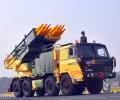
The US, China and the UK remain the top three defence spenders while India has the fourth largest military budget, followed by Saudi Arabia and Russia, according to the '2016 Jane's Defence Budgets Report', released by research firm IHS Markit.

Unimaginative increments, persistent refusal of funds have turned the military into an underfed child scared to ask for a full meal.

The session will commence with the maiden address of President Droupadi Murmu to the joint sitting of both Houses of Parliament. The address essentially highlights the government's achievements and policy priorities.

In a bid to address the rise of Al Qaeda and Taliban in Afghanistan and Pakistan, United States President Barack Obama's maiden budget has proposed more military aid to the two countries. US military aid to Pakistan has remained a matter of intense discussion, however, the Congressmen this time are pitching to increase non-military aid by linking it with Islamabad's success in the fight against terrorism. The budget also seeks to increase the non-military aid.
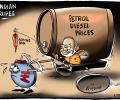
Oil sank to the lowest level in a month after shedding all of its gains from the US-Iran clash as traders waited to see whether any further hostilities will disrupt exports from the East Asia.

As a percentage of the military budget, the navy's share has fallen from 19 per cent in 2010-2011 to just 15.5 per cent this year. With the Indian Navy's annual budget declining steadily, security planners are reluctant to green light crucial projects, discovers Ajai Shukla.

There is nothing to be worried about as bilateral ties are robust with solid foundations. Both are on the same page on the economic and defence/security ties bilaterally and globally and that shall continue irrespective of change in political dispensation in either country, points out Dr Rajaram Panda.
India is confronted with a rapidly rising China and all its attendant consequences, says Harsh V Pant


China on Wednesday announced a 12.2 per cent increase in its defence budget taking the military spending for this year to $132 billion, far above India's $36 billion.

Confronting a slowdown in growth, China says it will only increase its defence budget by 7.6% this year, against the anticipated rise of between 20% and 30%. 'It is difficult to explain the reduction in the Chinese defence budget,' says Claude Arpi. 'Is there a hidden budget? Possibly!'
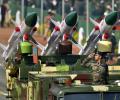
Most of the scanty 6.35% rise in the defence budget is accounted for by manpower and running expenses.

'There are major implications for India. Though there was a transparently thin attempt to project the troop reduction as intended to promote peace, the downsizing is actually part of plans to streamline and strengthen the PLA, capable of defending China's national interests at home and abroad,' says Jayadev Ranade.

Among others, China is developing the strategically located Gwadar port in Balochistan, which is aimed towards having a military presence, says a Pentagon report

16 Indian Army divisions face China, 20 face Pakistan and two divisions are reserves. This powerful signal can hardly be missed in China or Pakistan, notes Ajai Shukla.
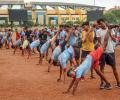
The greatest unknown in this risky initiative lies in the way human relationships will play out -- not just between the Agniveers, who will be competing with their fellows for permanent jobs beyond their four-year tenures -- but also between the Agniveers and existing full-time soldiers, warns Ajai Shukla.

The government should keep the interest of unemployed youth paramount and bring out various policy aspects of this initiative, Varun said.

India's historical focus on its continental borders has overshadowed its maritime ambitions, but that is changing quickly, notes Ajai Shukla.

The move towards indigenisation of defence procurement creates new opportunities for India's military industrial sector. The Government of India (GoI) has so far released five lists of items for positive indigenisation - these should be manufactured in India, rather than imported. Each item on these lists represents an opportunity for some local firm.
Moody's Investors Service on Thursday slashed India's economic growth projection to 8.8 per cent for 2022 from 9.1 per cent earlier, citing high inflation. In its update to Global Macro Outlook 2022-23, Moody's said high-frequency data suggests that the growth momentum from December quarter 2021 carried through into the first four months this year. However, the rise in crude oil, food and fertilizer prices will weigh on household finances and spending in the months ahead.

'The border stand-off and the uncertainties that come with it should be a wake-up call on what makes for real rather than illusory power,' observes T N Ninan.

'Any future course of action towards active participation in the alliance when formed would need a lot of deliberation, long term vision and should be in our best national interests,' notes Commodore Vengalil Venugopal (retd).

'While all would agree on the need to be ready to launch cross-border strikes on terror camps, there is sharp disagreement on how best to do it.' 'Through IAF fighters, or surface-to-surface missiles?' 'Or should army Special Forces be created to do the job?' 'If air strikes are the agreed priority, additional funding must be made available for the purchase of fighters and missiles.' 'If it is to be Special Forces, the army must be facilitated in raising a Special Forces Command,' notes Ajai Shukla.

China will use airpower to support Pakistan from the start of a war. China will use the opportunity to at least take Ladakh. Its growing navy will prevent India from blockading or attacking the Makran Coast. And thanks to Chinese weapons, Pakistan keeps expanding its forces, observes Ravi Rikhye.
India's cumbersome arms procurement procedures and a plodding Ministry of Defence bureaucracy have long been blamed for shortfalls in combat capability. Now there is another, more worrying, reason - a growing crisis of funds, magnified by the lack of tri-service coordination.
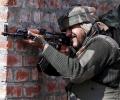
'An expanding army, rising salaries due to the 7th pay commission, and raised pensions due to OROP are consuming money at the cost of badly needed bulletproof jackets, rifles, artillery, submarines, warships and fighter aircraft,' notes Ajai Shukla.
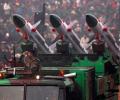
Defence experts want defence expenditure to be at 3% of GDP, which they consider minimum to counter the two-front threat from China and Pakistan, internal insurgencies, and dominating a 7,500 km coastline and the Indian Ocean beyond. What Arun Jaitley has given India this Budget is 2.16% of GDP, observes Ajai Shukla.
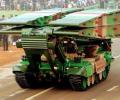
Given the importance of equipment modernisation, the overall defence budget should rise at least at the same pace as salaries and pensions, so that equipment modernisation is not hit.
